Fusaka Network Upgrade & Sui (SUI) Token Unlock: The Data-Driven Implications
Token Unlocks vs. Ethereum's "Trust Me, Bro" Upgrade
Decoding the Crypto Week: A Data Dive The coming week (December 1-7, 2025) presents a mixed bag for crypto investors. We're seeing a confluence of potentially bullish technical upgrades and bearish token unlocks. The question, as always, is which force will dominate the market narrative. Let's start with the unlocks. Sui (SUI) leads the pack, unleashing 55.54 million tokens (0.56% of total supply) on December 1st, worth roughly $85 million. Ethena (ENA) follows on December 2nd with 95.31 million tokens (0.64% of supply), valued at $27.2 million. And then there's Santos FC Fan Token (SANTOS) – a whopping 19% of its supply unlocked on the 1st. The market's priced these unlocks in to some extent, but it's tough to fully account for the selling pressure that can materialize when early investors or the project team decide to take profits. Now, for the counter-narrative: Ethereum's Fusaka upgrade, slated for December 4th. The Ethereum Foundation touts this as a critical step in scaling blob throughput after PeerDAS activation. PeerDAS (Peer Data Availability Sampling) is supposed to significantly improve efficiency. The upgrade also optimizes execution and consensus layers, promising better L1 performance and user experience. Weekly Preview | Fusaka network upgrade to be activated on Ethereum mainnet; Sui (SUI) to unlock tokens worth over $80 million. The problem? Upgrades are always a "trust me, bro" situation until they actually deliver tangible results. The market loves to *anticipate* positive outcomes, but the actual *impact* often lags the hype. How long will it take for users to see measurably faster transaction speeds or lower fees after Fusaka? That's the key question, and the answer isn't immediately apparent.ETF Flows, Volatility Indices: Reading the Tea Leaves
ETF Flows and Bitcoin Volatility: Signals Amidst the Noise Adding another layer to the mix, we have the ETF market. Recent data shows Bitcoin spot ETFs experiencing net inflows, with ARKB (Ark Invest and 21Shares) and FBTC (Fidelity) leading the charge. However, BlackRock's IBIT saw a net outflow of $114 million. This discrepancy is interesting (and something I'll be watching closely). Is this a sign of profit-taking in IBIT, or a broader shift in investor sentiment? It's too early to tell, but the ETF flows are definitely something to keep an eye on. CME Group and CF Benchmarks are launching two new Bitcoin volatility indices on December 2nd: the CME-CF Bitcoin Volatility Real-Time Index (BVX) and the CME-CF Bitcoin Volatility Settlement Index (BVXS). These are forward-looking indicators designed to measure market expectations of Bitcoin price volatility over a 30-day period. And this is the part of the report that I find genuinely puzzling. If the market truly believed that the Fusaka upgrade was a guaranteed success, wouldn't we see a *decrease* in expected volatility? The fact that CME is launching these indices *now* suggests that there's still a significant amount of uncertainty baked into the market's expectations. Or maybe CME is just trying to capitalize on the inherent volatility of crypto, regardless of any specific upgrade. dYdX is launching a one-month pilot program for liquidation rebates, starting December 1st. This is an attempt to incentivize traders and potentially reduce the severity of liquidation cascades. It's a novel approach, but the long-term effectiveness remains to be seen. Will it actually attract more traders, or will it simply reward those who are already active on the platform?VanEck's Crypto Crystal Ball: Take with a Grain of Salt
The VanEck Crystal Ball: A Grain of Salt VanEck released their 2025 crypto predictions, projecting Bitcoin to hit $180,000 and Ethereum to exceed $6,000 in Q1, followed by a retracement and then a recovery. They also predict the U.S. will embrace Bitcoin with strategic reserves and increased crypto adoption. Now, I respect VanEck's analysis, but let's be realistic. Predictions are just that – predictions. They acknowledge that their 2024 crypto predictions got a batting average of 0.566, which is good enough to keep them in the game, but it’s not perfect. There are so many variables at play in the crypto market that any long-term forecast should be taken with a hefty grain of salt. And who really knows what Trump's crypto policy will look like beyond surface-level soundbites? Token Unlocks vs. Upgrade Hype: A Zero-Sum Game? Ultimately, the coming week boils down to a tug-of-war between token unlocks (potential selling pressure) and the hype surrounding Ethereum's Fusaka upgrade (potential bullish sentiment). I suspect the unlocks will have a more immediate impact, at least in the short term. Upgrades take time to fully materialize, while token unlocks are a guaranteed event. Traders need to be aware of these dynamics and manage their risk accordingly. Don't get caught up in the hype cycle. Focus on the data, and remember that the market can be irrational for longer than you can stay solvent. Is "Fusaka" Just Another Overhyped Fork? The market loves a good story, and the "Fusaka upgrade will solve all our problems" narrative is certainly compelling. But I've seen this movie before. How many Ethereum upgrades have promised to revolutionize the network, only to fall short of expectations? The data suggests that upgrades are often priced in *before* they actually deliver results, leading to a "buy the rumor, sell the news" scenario. Until I see concrete evidence of Fusaka's impact on transaction speeds and fees, I'm remaining cautiously skeptical.Related Articles

Brooke Rollins: New USDA Gig and the Internet's Skepticism
Title: Brooke Rollins Promises "Real Relief" Is Coming—Yeah, Right So, the Trump administration's Ag...

That VTI 'What If' Article: Why It's Mostly Garbage
So, I pulled up my portfolio this morning. September 4, 2025. Ten years to the day since I dropped a...
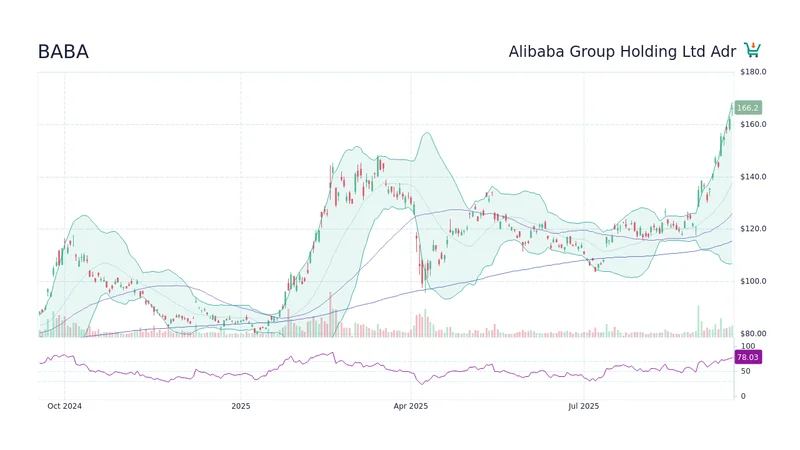
Baba Stock: The Price Reality
Alibaba's Latest Plunge: Who's Really Surprised by This Whole Military Mess? Another Day, Another Ch...

ABAT's Stock Surge: Separating the News from the Financial Reality
The market loves a good story, and American Battery Technology Company (NASDAQ: ABAT) just delivered...

Immaculata's Open House: A Data-Driven Breakdown for Prospective Students
On the surface, the announcement is unremarkable. Immaculata University, a private institution nestl...

Adrena: What It Is, and Why It Represents a Paradigm Shift
I spend my days looking at data, searching for the patterns that signal our future. Usually, that me...